
Sailing Terms: A Beginner’s Guide to 40+ Words You’ll Hear on the Water
Sailing has its own language – and it can sound like a foreign one when you first step aboard. Port, starboard, halyard, luffing… even seasoned travelers can feel lost when a captain starts rattling off sailing terms they’ve never heard. The good news? You don’t need to memorize a dictionary. You just need enough vocabulary to follow along, stay safe, and feel confident on deck.
Whether you’ve booked a sailing charter for your next vacation or you’re simply curious about how all of this works, this guide groups the most common sailing terminology into plain-English categories. We’ll cover the parts of a sailing boat, sails and rigging, wind directions, maneuvers, navigation basics, and – for fun – a handful of everyday phrases you probably didn’t know came from sailing. Think of it as a pocket glossary you can skim before you board. For a broader look at how sailing actually works, check out our full beginner’s guide to sailing.
Boat Anatomy – The Parts You’ll Point At
Let’s start with the boat itself. On a charter, the captain handles the technical work – but knowing bow from stern means you can follow instructions and stay out of the way when it matters.
- Bow – the front of the boat. When someone says “move to the bow,” head forward.
- Stern – the back. This is usually where the cockpit and helm are.
- Port – the left side when you’re facing the bow. Marked with a red light at night.
- Starboard – the right side. Marked with a green light. The word comes from Old English steorbord – the side where Viking helmsmen mounted their steering oar.
- Hull – the main body of the boat, the part sitting in the water.
- Keel – a weighted fin underneath the hull that keeps the boat from sliding sideways and helps prevent capsizing.
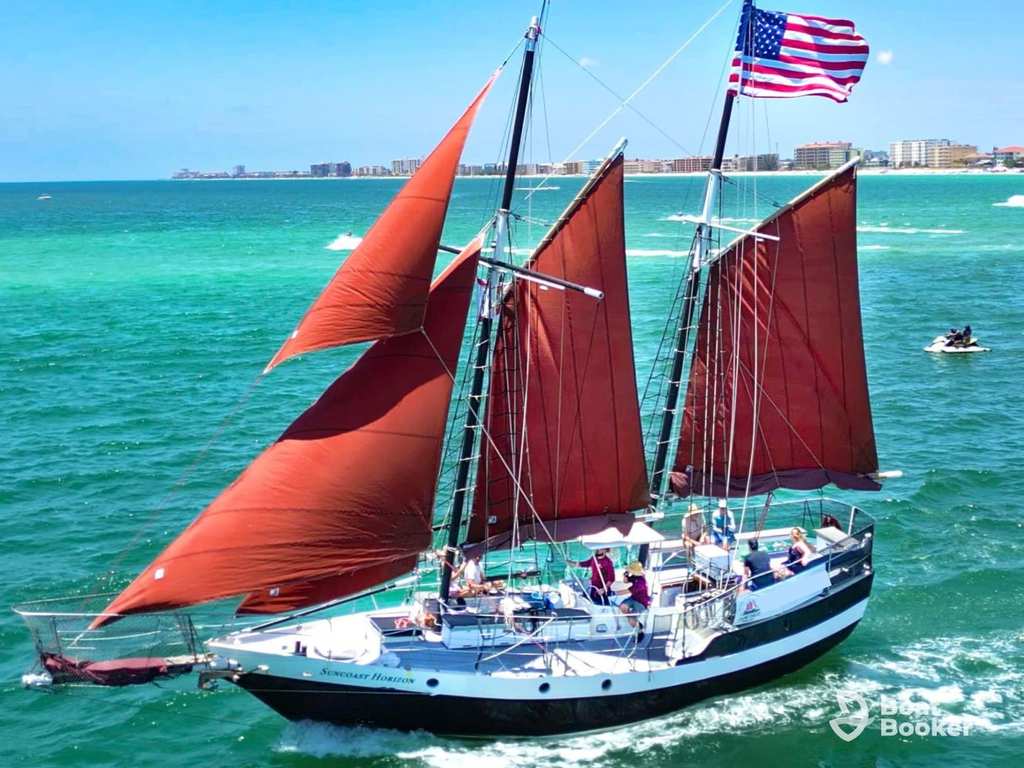
- Mast – the tall vertical pole that holds the sails up. On most charter sailboats, there’s one mast (called a sloop rig).
- Boom – the horizontal pole attached to the bottom of the mast. It swings side to side, so duck when it moves. Both the mast and boom are types of spars – rigid poles that support the sails.
- Helm – the steering station, which could be a wheel or a tiller (a lever connected directly to the rudder).
- Rudder – a flat blade under the stern that pivots to steer the boat.
- Cockpit – the recessed area in the stern where the crew sits and the captain steers.
- Deck – the flat surface you walk on.
- Cabin – the enclosed living space below deck.
- Galley – the kitchen. Yes, it has its own name.
- Head – the bathroom. Also its own name.
- Berth – a sleeping space, or sometimes a docking spot at a marina (context will tell you which).
- Draft – how deep the boat extends below the waterline. Important for shallow anchorages.
- Beam – the widest point of the hull. A wider beam usually means a more stable ride.
- Gunwale (pronounced “gunnel”) – the upper edge of the hull where the deck meets the side.
- Transom – the flat panel across the stern.
- Cleat – a small metal or plastic fitting used to secure lines. You’ll see them everywhere on deck.
- Pulpit – the railing at the bow. The railing at the stern is sometimes called the pushpit.
- Bimini – a canvas sun shade over the cockpit. On a hot charter day, it’s your best friend.
Sails, Rigging, and Lines
Now for the engine room – except there’s no engine. The sails and the web of cables and ropes that support them are what make a sailboat go.
The sails:
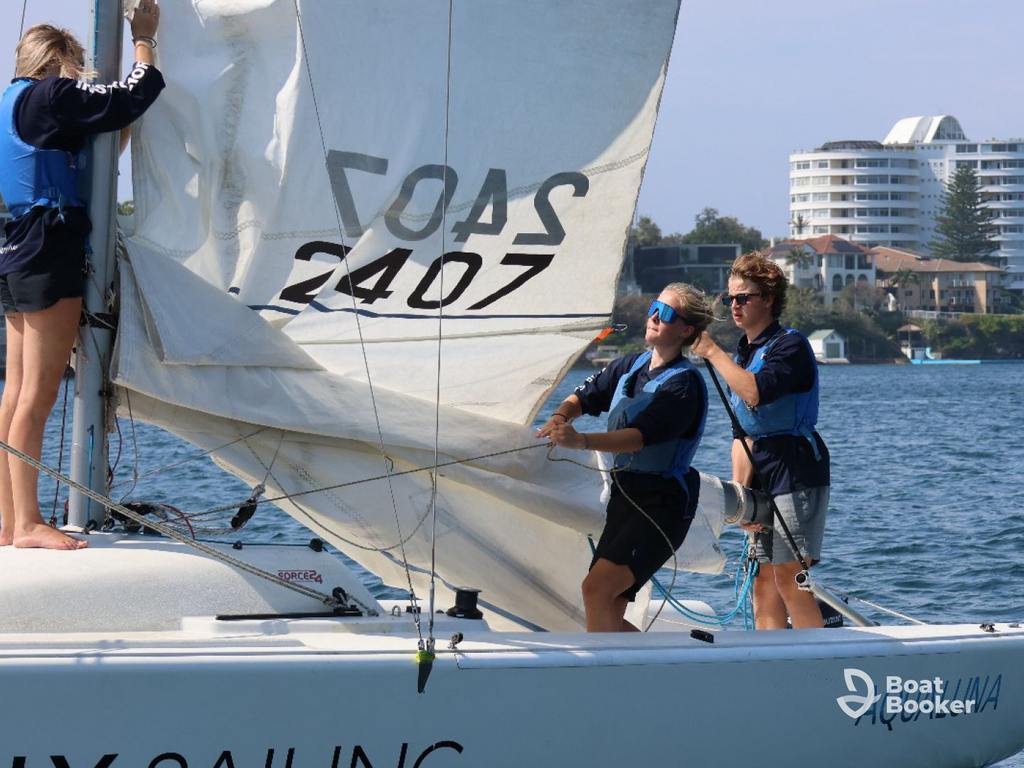
- Mainsail – the large primary sail attached to the mast and boom. It’s the workhorse.
- Jib (or headsail) – a smaller sail set forward of the mast. Most charter boats have one.
- Genoa – a larger version of the jib that overlaps the mast. A genoa extends past the mast, while a jib doesn’t – that’s the key difference.
- Spinnaker – a big, balloon-shaped sail used when sailing downwind. You’ll mostly see these on racing boats, less often on charters.
The rigging:
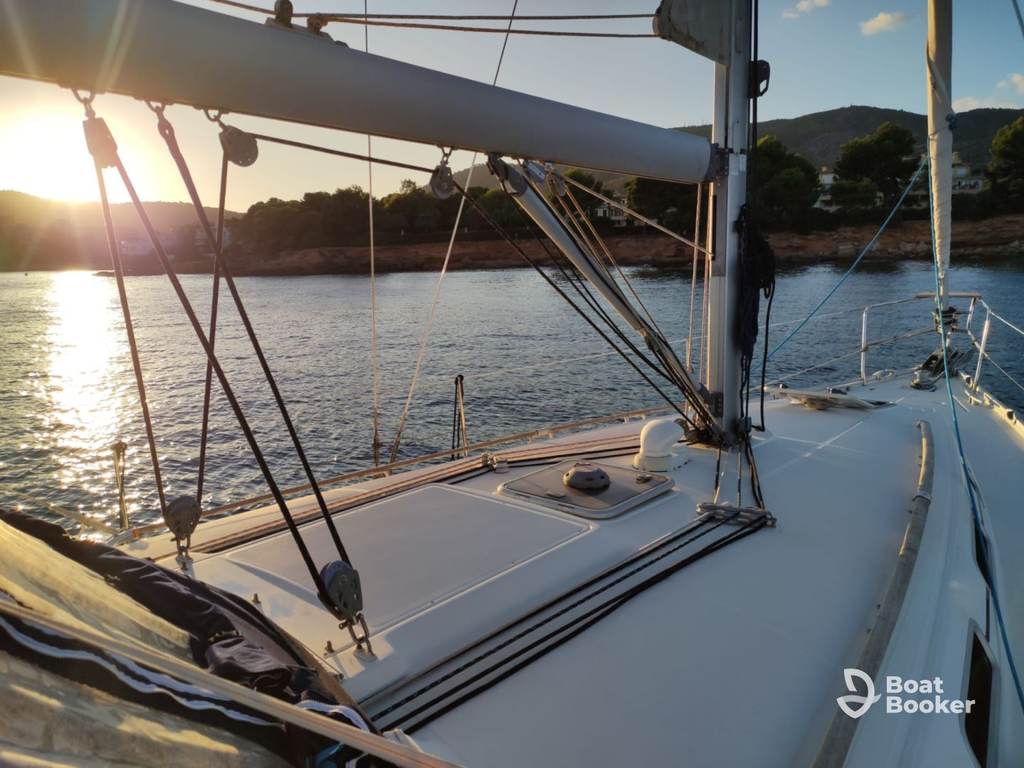
- Standing rigging – the permanent cables that hold the mast in place. These don’t move during sailing.
- Shrouds – standing rigging cables running from the mast to the sides of the boat.
- Forestay – the cable running from the mast to the bow. The jib usually attaches to it.
- Backstay – the cable running from the mast to the stern.
- Running rigging – the lines you actively pull and adjust to control the sails.
- Halyard – a line used to hoist a sail up the mast.
- Sheet – a line used to control the angle of a sail. The “jib sheet” controls the jib; the “mainsheet” controls the mainsail.
- Outhaul – a line that pulls the mainsail along the boom to flatten its shape.
- Boom vang (or just vang) – hardware that pulls the boom downward to control sail shape.
Sail handling:
- Reefing – making a sail smaller by folding or rolling part of it. Crews reef when the wind picks up and full sail would be too much.
- Furling – rolling a sail around a stay or inside the mast for storage or size reduction. Many charter boats have roller-furling jibs, so sail handling is much easier for guests.
Why Sailors Never Say “Rope”
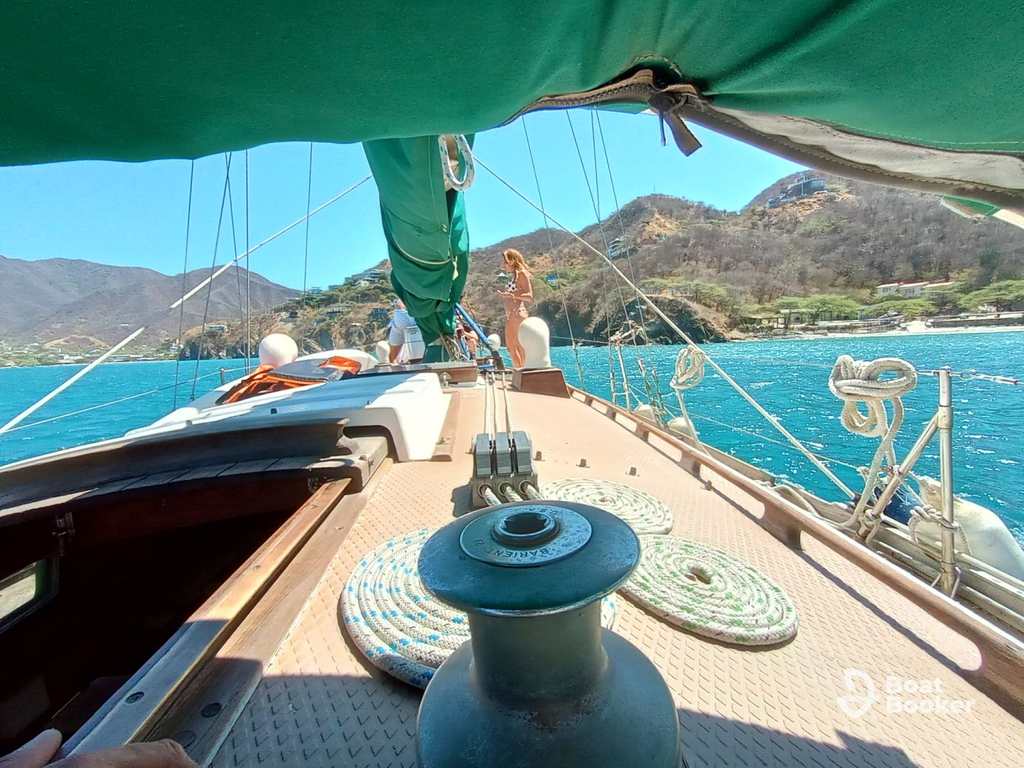
On a boat, the word is line, not rope. Once a rope has a job – hoisting a sail, controlling a sheet, tying to a dock – it earns a specific name. Calling it “rope” marks you as a newcomer. It’s a small thing, but now you know.
Wind and Direction Terms
Sailing is a constant conversation with the wind. These terms describe where the wind is coming from relative to the boat and how you’re angled into it.
- Windward – the side the wind is coming from. If the wind hits your right cheek, the starboard side is windward.
- Leeward (pronounced “loo-ard”) – the sheltered side, away from the wind.
- True wind – the actual wind direction and speed as measured from a fixed point.
- Apparent wind – the wind you feel on the boat, a combination of true wind and the boat’s own motion. It shifts as you speed up or change course.
- In irons (or head to wind) – pointing directly into the wind with sails flapping uselessly. The boat stalls. It’s not dangerous, just frustrating – the captain will fall off to one side to get moving again.
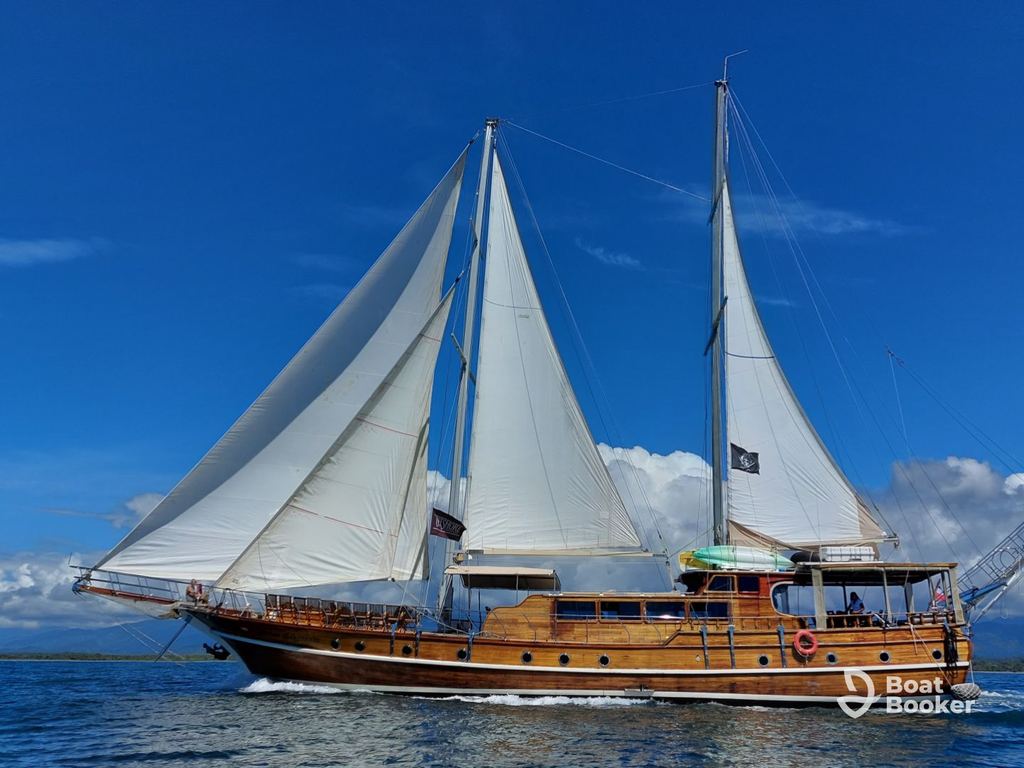
Points of sail describe the angle between the boat and the wind:
- Close-hauled (or beating) – sailing as close to the wind as possible, roughly 35–45 degrees off. The boat heels a lot here. You can’t sail directly into the wind, so this is as close as you get.
- Beam reach – wind hitting the boat from the side, roughly 90 degrees. Often the fastest and most comfortable point of sail.
- Broad reach – wind coming from behind and to one side, roughly 120–150 degrees. Fast and fun.
- Running (or dead run) – wind coming from directly behind. Sounds easy, but it requires careful attention to avoid an accidental jibe.
Maneuvers and Commands
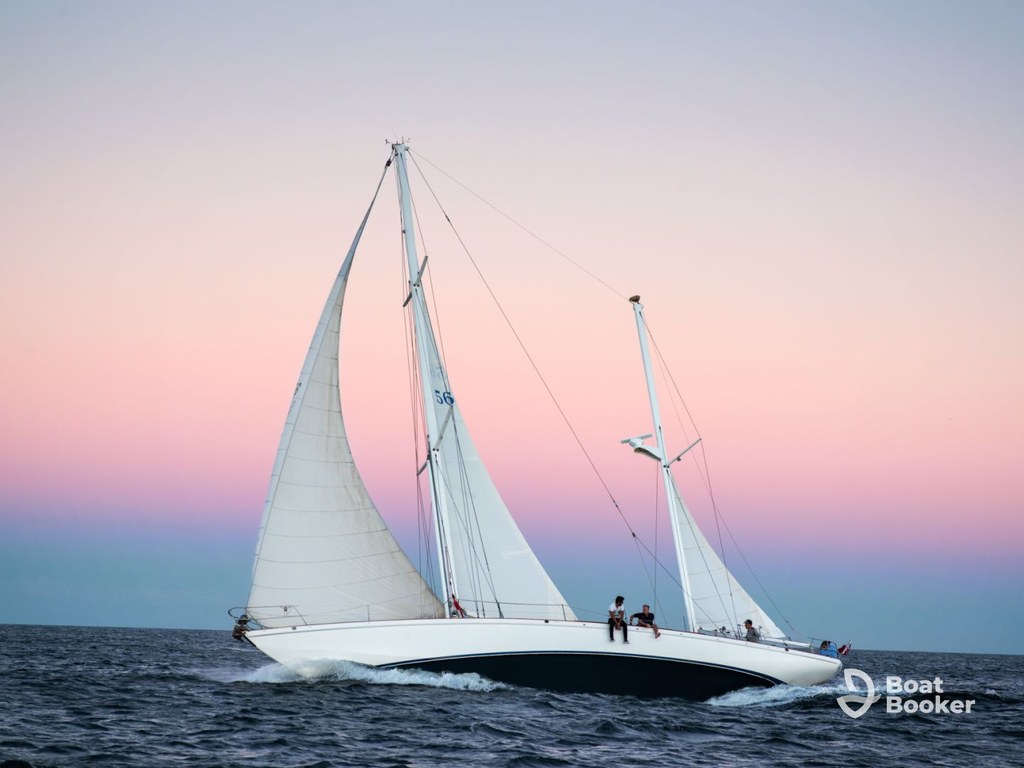
These are the action words – what the crew does to change direction, adjust speed, or park the boat. On a charter, you’ll mostly hear the captain call these out. Knowing what they mean keeps you safe and also lets you help if you want to.
- Tacking – turning the bow through the wind so the wind switches from one side to the other. The captain might call “Ready about!” to warn the crew, then “Hard a lee!” to execute.
- Jibing (or gybing) – turning the stern through the wind. The boom swings across fast, so keep your head down. This is the maneuver where the “duck when the boom moves” rule matters most.
- Coming about – another way to say tacking. Same move, different phrase.
- Heeling – when the boat leans to one side under wind pressure. Perfectly normal – boats are designed for it. It just feels dramatic the first time.
- Luffing – when a sail flaps because it’s not properly angled to the wind. The captain “trims” the sail to stop it.
- Trimming – pulling a sheet in to tighten a sail and catch more wind.
- Easing – letting a sheet out to loosen a sail.
- Heading up – turning the boat more toward the wind.
- Bearing away (or falling off) – turning the boat away from the wind.
- Heave to – a technique to park the boat mid-sail by setting the sails and rudder to counteract each other. The boat drifts slowly and steadily. Crews do this for lunch breaks, rough weather, or rest.
- Casting off – untying the dock lines and leaving the marina.
- Mooring – attaching the boat to a fixed buoy or mooring ball rather than anchoring.
- Docking – bringing the boat alongside a pier or slip.
Navigation and Measurement Terms
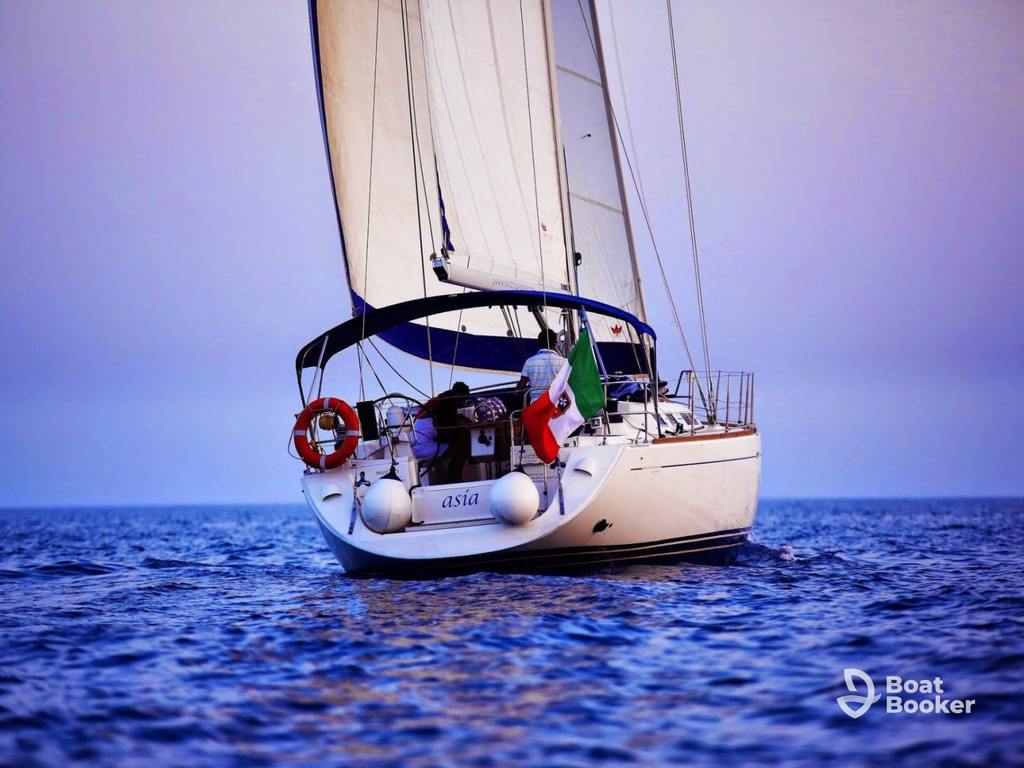
You don’t need to navigate the boat – that’s what the captain is for. But these terms come up often, especially when discussing distance, speed, and route.
- Knot – one nautical mile per hour. According to NOAA, a knot equals about 1.15 statute (land) miles per hour. So a boat doing 8 knots is traveling about 9.2 mph.
- Nautical mile – 1.15 land miles, or 1,852 meters. It’s based on one minute of latitude, which is why it’s the standard unit at sea.
- Fathom – 6 feet (1.83 meters). Used to measure water depth. The word comes from the Old English for “outstretched arms” – roughly the span of a person’s arms held wide.
- Bearing – the compass direction to a specific point (a lighthouse, another vessel, your destination).
- Heading – the compass direction the boat’s bow is pointed.
- Course – the intended path of travel, which may differ from heading due to current and wind.
- Waypoint – a specific GPS coordinate used for route planning.
- Chart – a nautical map showing depths, hazards, channels, and navigation aids. Most charter boats now use a chartplotter (a GPS-based digital chart).
- Buoy – a floating marker. Red and green buoys mark safe channels.
- Channel marker – a buoy or sign that defines the edges of a navigable waterway.
- VHF radio – the standard marine communication radio. Channel 16 is the universal distress and calling frequency.
- Mayday – the international distress call, used only in life-threatening emergencies.
- Dead reckoning – estimating your position based on your last known position, speed, and direction. It’s the old-school way of navigating, largely replaced by GPS – but the term still comes up.
Sailing Terms You Already Use (Without Knowing It)

English is full of phrases borrowed from centuries of sailing. Here are a few you’ve probably said without realizing where they came from.
- “Taken aback” – on a ship, sails are “aback” when the wind suddenly hits them from the front, stopping the boat cold. Being taken aback means you’re caught off guard – on the water, it literally meant the wind shifted without warning.
- “By and large” – “by” meant sailing close to the wind; “large” meant sailing with the wind behind you. A ship that handled well “by and large” performed in all conditions. Today it just means “generally.”
- “The bitter end” – the “bitter end” is the last length of anchor line attached to the post (called the bitt) on deck. When you’ve reached the bitter end, there’s nothing left to let out.
- “Above board” – anything visible on the deck (above the boards) was open and honest, as opposed to cargo hidden below. If you’re above board, you have nothing to hide.
- “Three sheets to the wind” – sheets control the sails. If three sheets are loose, the sails flap wildly and the boat staggers unpredictably. Sound like anyone you’ve seen after a few drinks?
- “Loose cannon” – warships carried heavy cannons on wheeled carriages. If one broke free in rough seas, it rolled across the deck crushing anything in its path. A loose cannon is someone dangerous and unpredictable.
Next time one of these phrases slips out in conversation, you’ll know it started at sea.
Frequently Asked Questions About Sailing Terms
Sloop – one mast with a mainsail and one headsail (jib or genoa). This is what most charter sailboats are.
Catamaran – a twin-hulled boat, wider and more stable than a monohull. Popular for group and family charters. Learn more in our guide to catamarans.
Ketch – two masts, with the shorter one (mizzen) behind the main mast.
Schooner – two or more masts, with the forward mast shorter than the aft. Often seen on tall ship tours.
Dinghy – a small, open sailboat, usually crewed by one or two people. Great for learning the basics.
Sloop – one mast, one headsail, one mainsail. The standard for charter boats.
Cutter – one mast with two headsails.
Ketch – two masts, with the aft (mizzen) mast shorter and positioned forward of the rudder post.
Yawl – similar to a ketch, but the mizzen mast is behind the rudder post and usually smaller.
Schooner – two or more masts, with the aft mast taller.
Cat rig – one mast set far forward, one sail, no headsail. Simple and common on small dinghies.
Have you picked up any sailing terms on a charter that confused – or delighted – you? If you’ve sailed in Croatia, Greece, or anywhere else and heard a term we missed, drop it in the comments. We’d love to add it. And if anything here is off, let us know – sailors are great at keeping each other honest.